My group works on several detectors designed to search for “millicharged particle” signatures of dark sectors. We work on the milliQan detector at CERN that recently released the world’s strongest constraints on a wide range of masses. I am the spokesperson for the FORMOSA experiment in the forward region of the LHC and help to lead the FLAME experiment that runs in intensity frontier facilities at LANL and FNAL.
milliQan

The milliQan detector is comprised of around a hundred scintillator volumes connected to PMTs. It has been operational at the LHC since 2018. The scintillator volumes are large to capture the minuscule energy expected from a millicharged particle traveling through the detector. My group helps to build and operate the detector. I am responsible for the physics analysis efforts for the experiment. We have carried out two searches for millicharged particles with world leading sensitivity (most recent search published in late 2025: Phys. Rev. Lett. 135).
More details on the detector can be found here.
FORMOSA

The FORMOSA detector is a proposed experiment for the HL-LHC that is 25 times larger than milliQan and would be ideally sited in the proposed Forward Physics Facility. In the forward region the flux of millicharged particles can be increased by several orders of magnitude making this an ideal location for such an experiment. The large muon flux makes it challenging however, and so we have installed the FORMOSA demonstrator to prove the feasibility of the detector design.

The FORMOSA demonstrator was installed in 2024 and ran very successfully in a cavern 500m from the ATLAS collisional point until the end of 2025. The construction was carried out entirely by undegraduate students at UC Davis and the supervision of Jacob Steenis (UCD grad student). Juan Tafoya (UCD postdoc) and Jacob led the successful operation of the detector and are now working to complete a first search using the collected data.
More details on FORMOSA can be found here.
More details on the FPF can be found here.
FLAME
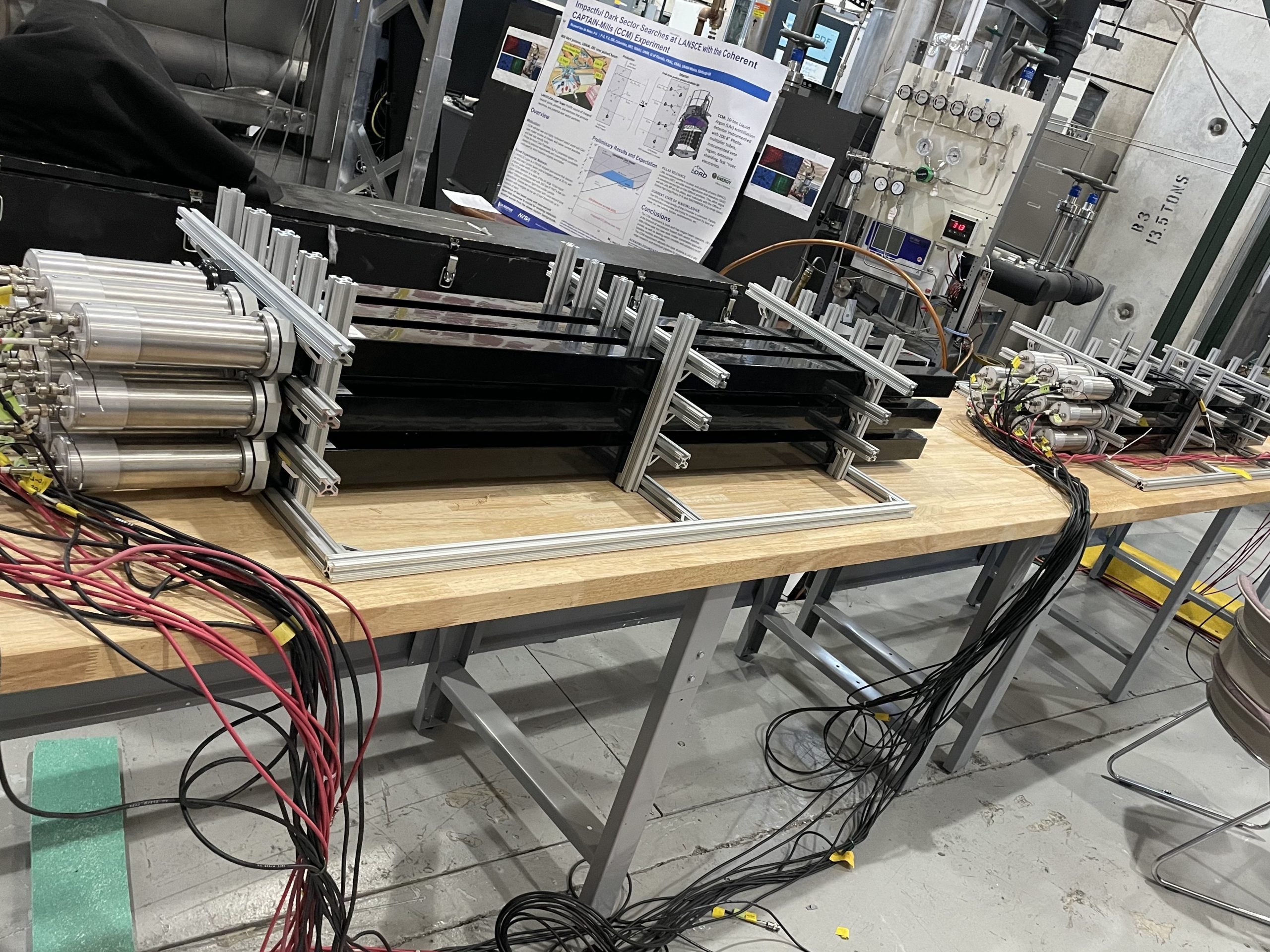
The LHC provides the highest energy collisions ever achieved at a particle collider. However, the production of lighter millicharged particles may be significantly increased at high intensity facilities. The Fermilab-Los Alamos Millicharge Experiment (FLAME) is designed to achieve sensitivity by running flexibly at two locations: the 800 MeV LANSCE facility at LANL and the 120 GeV Main Injector at Fermilab. Samantha Kelly (UCD grad student) is working to construct and operate a FLAME prototype detector as well as analyze the collected data.
More details on the detector can be found here.